
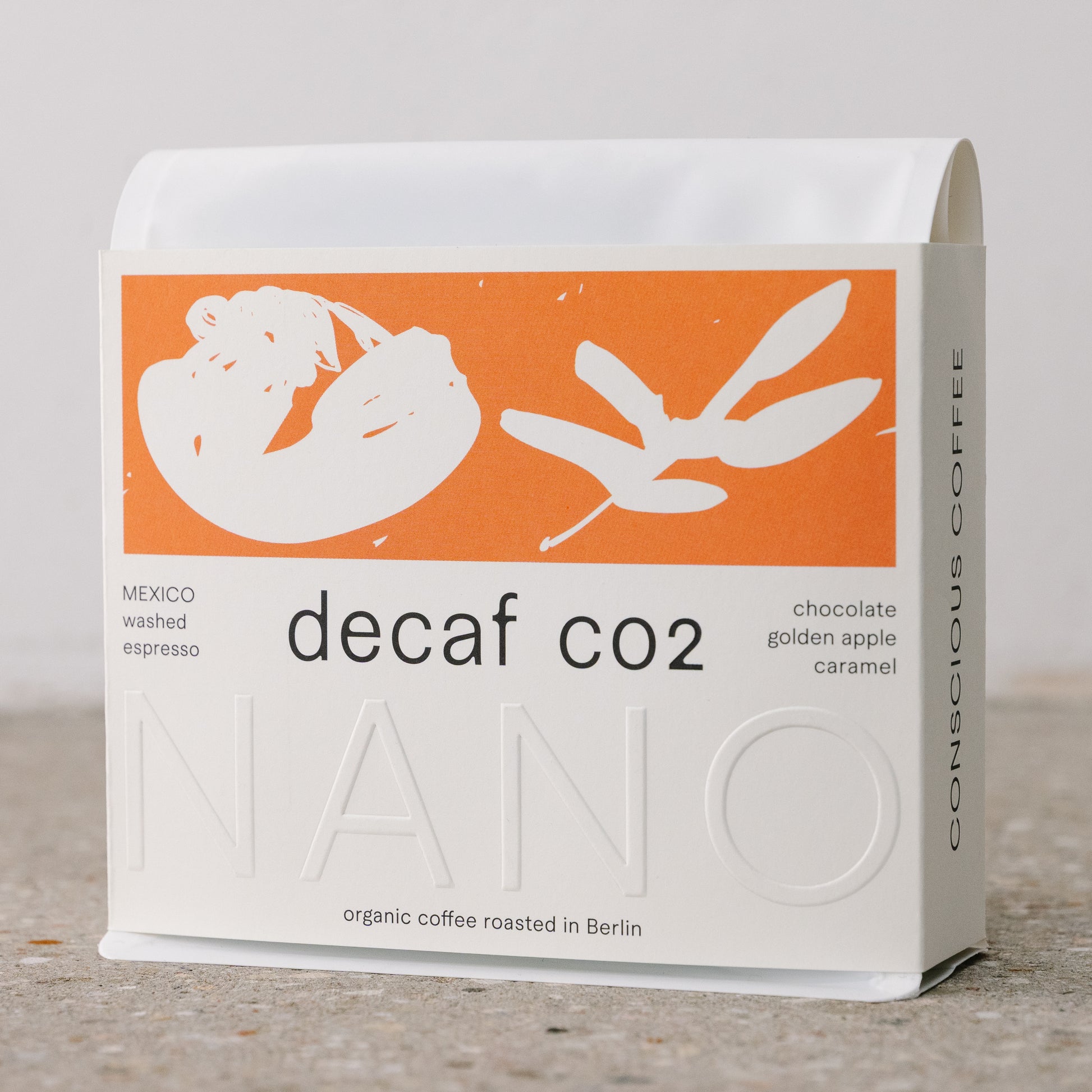

Mexico | Decaf CO₂ [organic]
Mexico | Decaf CO₂ [organic]
organic | 100% Röstkaffee
Couldn't load pickup availability
This espresso roast also works beautifully as a bold and sweet filter coffee.
You will find flavors of chocolate, golden apple and caramel.
100 % Arabica
whole beans
This coffee is a product of the highest quality, cultivated and roasted in respectful interaction between man and nature - that's what NANO KAFFEE stands for.
Stats
ORIGIN: Mexico
REGION: Motozintla, Sierra Mariscal, Chiapas
ALTITUDE: 1,100 - 1,350 masl.
FARM/GROWER: Las Hortensias
IMPORTER: List Beisler
VARIETY: Bourbon, Caturra, Catimor, Typica
PROCESSING: washed
DECAF METHOD: CO2
FLAVOUR: Chocolate, golden apple, caramel
Quick info
This special DECAF CO2 originates from the mountainous region of Chiapas, Mexico's most important co ee-growing region. It is characterized by an ideal climate, which gives rise to one of the most species-rich flora and fauna in the world. In the cup, we find intense chocolate notes accompanied by the fruitiness of golden apples and a caramel sweetness finish. Ca eine-free, full of flavor — thanks to the uniquely gentle, certified organic decaffeination process.
Farmers
The rugged mountain landscape of the subtropical rainforest of Chiapas is home to the famous ancient Mayan ruins of Palenque, Yaxchilán, and Bonampak. The region also has one of the world's largest concentrations of indigenous peoples. The majority of the people living here are descended from the Maya.
In Mexico, coffee is grown by more than half a million farmers, 95% of whom are smallholders cultivating less than three hectares. 85% of Mexican coffee farmers are indigenous Mexicans, deeply rooted in indigenous culture and living in peaceful harmony with the environment since all along.
Las Hortensias is a group of small farmers from Chiapas who produce this coffee. Their worldview and closeness to nature and earth naturally influence the way they farm. In this case, farming means careful manual labor on jungle-like slopes. Large machinery cannot really be used here. Therefore, much of the work, from cultivation to harvesting and processing, is done by hand.
Nature
The coffee is organically grown in the Chiapas region. This is Mexico's southernmost state, bordering Guatemala to the east and the Pacific Ocean to the south. The region is characterized by a contrasting landscape of valleys, volcanic mountains, and tropical forests. The climate in Chiapas is ideal for a diverse and productive agriculture, making the region one of the most important for coffee cultivation in all of Mexico — 40% of the country's total production comes from Chiapas. Mexico is also one of the world's largest exporters of organic coffee.
Due to the humid, tropical climate, the vegetation is referred to as "bosque de niebla" ("fog forest"), which is of great importance for the microclimate, as the clouds coming from the Pacific bring a lot of water inland.
The coffee grows and thrives under tall shade trees in a jungle-like environment. Shade-grown coffee ripens slowly, developing natural sugars and complex flavor profiles. Shade-grown coffee fields also provide habitat for many species of birds and butterflies, absorb carbon dioxide from the atmosphere and release oxygen in return, and help maintain soil moisture, which in turn minimizes soil erosion.
"Sierra Madre de Chiapas" is the name of the section of the volcanic mountain range known as the "Cordillera" that runs through North and South America. The mineral-rich soil is another factor why coffee plants can thrive here well without the need for chemical fertilizers.
The combination of high altitude, rich soil, and tropical climate guarantees ideal growing conditions and creates the necessary conditions for cultivating coffee of the highest quality.
Impact
The coffee is traded transparently and grown organically in harmony with the environment. This means that an important part of the added value remains with the local population without harming the flora, fauna, or people.
The coffee plantations of the small farmers who produced this coffee are located near the El Triunfo Nature Reserve, a beautiful habitat for one of the most species-rich biodiversities in the world. This reserve encompasses the largest contiguous cloud forest in Mesoamerica and serves as a refuge for thousands of plant and animal species. El Triunfo is a rare and valuable protected area that requires ongoing conservation. This makes it all the more important that coffee in Chiapas is grown without negative consequences for the immediate environment.
Decaf CO²
Caffeine is just one of many components of coffee.
The Carbonic Natural™ process used for this coffee gently extracts only the caffeine. The full flavor potential of the green coffee is preserved without losing valuable components that develop characteristic aromas during the roasting process.
This is only possible with a lot of time (about ten times as much as with conventional decaf processes), technical expertise, and an understanding of specialty coffee.
The unique decaffeination process uses natural carbon dioxide from the Vulkaneifel region in Rhineland-Palatinate. The green coffee is moistened with warm water and steam at 25°C, causing the beans to swell and open up. At a pressure of around 70 bar, the liquid carbon dioxide extracts parts of the caffeine from the coffee without dissolving other components. This cycle is repeated several times until the caffeine is almost completely removed from the bean.
The demand for natural, sustainable coffee consumption is increasing. The caffeine is extracted in a natural, certified organic, and particularly gentle way—so that everything else remains in the bean. Carbonic Natural™ thus sets the premium standard for specialty coffee.
Taste
The combination of high altitude, mineral-rich soil, and tropical climate creates the necessary conditions for growing the highest quality coffee, which has sufficient time and optimal conditions to develop special flavors.
Coffee from Chiapas typically has a balanced flavor profile characterized by notes of chocolate, caramel, or citrus fruits.
The coffee grows and thrives under tall shade trees in a jungle-like environment. This allows the coffee cherries to ripen more slowly, developing natural sugars and complex flavor profiles.
The coffee is not only certified organic, but also carries the internal SHG and EP labels. The first stands for "Strictly High Grown" and indicates that the coffee was grown at certain altitudes. EP stands for "European Preparation." Which is the internal designation used to indicate particularly careful sorting and special quality control of the coffee beans.
Despite being decaffeinated, DECAF CO2 is a sweet coffee with an intense flavor and special aromas. The chocolatey notes and hints of caramel are indicative of its origin in Chiapas, Mexico's largest coffee-growing region. The distinctive notes of golden apple testify to the uniqueness of this coffee's history.
A treat with history, full of flavor, completely caffeine-free.
—
This coffee is a product of the highest quality, cultivated and roasted in respectful interaction between humans and nature - that is what NANO KAFFEE stands for.
For organic certification: DE-ÖKO-070
Share
![Mexico | Decaf CO₂ [organic]](http://nano-kaffee.de/cdn/shop/files/NanoProduct4842.jpg?v=1758639107&width=1445)
![Mexico | Decaf CO₂ [organic]](http://nano-kaffee.de/cdn/shop/files/25-decaf-c02.jpg?v=1764533765&width=1445)